Lonnie James–Interview

Describe your creative space. Do you work at home, in public spaces, etc.?

My favorite creative space is in my home at night after most of the world has long been in bed. I find that I’m most creative at night, so in my living room in between 1am and 4am seems to be the time and space when I feel most comfortable. Honestly, I think it’s the isolation. However, I have done a great deal of work in a studio setting within my college experience with 20 other people in a room where I just sort of have to phase everything and everyone out. I may be there in body but my mind has long gone.

What kind of materials do you use? What mediums do you work in?

My favorite materials to use are Pilot G-2 Pens and India Ink. I’ve also really started to enjoy the use of charcoal. So, I’m sort of all over the place because I think I’m still finding myself as an artist—but what is definitively clear is that dark colors, and lots of use of ink is a very distinctive characteristic that seems to be at the center of my style and/or chosen aesthetic.

What is your routine for art? Do you always sketch first?

My routine for art is to use it as a catalyst for expression when I’m unable to communicate my feelings orally…which seems to be often. I hold a lot of things in, and I suffer from various mental illnesses such as PTSD and Depression. When I’m having bad days, my art becomes my lifeline. It gives me a constructive way of dealing with the feelings and thoughts I’m experiencing.

How long have you been making art? When did you start making art?

I started when I was young and gave it up because of a lack of value in what I was doing. I didn’t think I was any good or that people would care about what I was doing, so I stopped. My professor at BGSU, named Theresa Williams, reminded me what being a real artist was about. It’s not about recognition, or money, it’s about self-expression, self-exploration, and honesty. So I started again recently in college because I started to realize that there is a whole world of people who are open minded enough to appreciate things that I can create.

Who is your intended, or ideal, audience? Who do you make art for?

My intended audience has really only been me up to this point. I never really thought that anyone else would care to see it much. I’ve gotten to a point in my journey as an artist that I feel it’s important to create my art for myself, and if others appreciate it, great, but my intentions for art are really just get my feelings out there in the only way I know how. It just took on this medium with the guidance of people much wiser than myself who showed me that I could do this to heal myself.

What inspires you to create? If you are blocked, what do you do?

My feelings are my biggest source of inspiration. Especially my sadness, and depression. I’ve come to the conclusion that I wouldn’t be who I am artistically without my sadness and depression. It’s sort of tragic to say in a way, but I’m thankful in some ways for having a hard life because I’ve survived, and now I have so much fuel to create things. It’s a double edged sword though, because it’s not easy struggling. If I’m feeling blocked I listen to music and watch films. They inspire me and make me feel things that make me want to create something.

What other things do you do besides art? Do you dance or play golf, etc.?

I’m a filmmaker, and a musician. I was in a Thrash Metal band for years, and then after that went south, I decided to go back to school for film. Now I have a real passion for creating films, and writing, as well as music. I’m also a big fan of video games. I don’t have as much time to play these days but I love to sit down and play a good Role Playing Game from time to time.

What is your favorite part of the creative process?

I think when I finish. (haha) Honestly the feeling I get when I’m done is such a relief and a sense of accomplishment that it has to be my favorite part. Other than finishing, my favorite is the moment your idea starts to really take shape. When you’re drawing and maybe at first you’re not really sure what you’re drawing, you’re just letting your hand free flow over the paper and then suddenly in the assortment and array of lines and shapes that you’ve created, you identify something coherent, and something that you didn’t think was possible. I love that “breaking ground on a new frontier” sort of feeling when I feel like I’m trekking into uncharted territory artistically. Every so often that happens, and I’m shocked at what I’ve accomplished.

What is your advice to aspiring artists?

I almost don’t feel qualified to give people advice. However, if I gave any advice at all, I’d say think outside of the box. Don’t always aspire to look exactly the way other people might do their work. I would also say don’t be afraid to really express yourself. Art isn’t always politically correct, and it’s not always about playing it safe. It’s ok not to stay within the lines, and it’s ok for something not to be perfect. Don’t allow the idea or aspiration of perfection lock you up like it has done to me. Just do something, anything. Put pen to paper. I highly suggest checking out Lynda Barry’s Syllabus because she comes up with some ways for anyone to make something even if you’re locked up and have creator’s block.


Check out Lonnie’s work in Volume 4, Issue 2.
Volume 5, Issue 2 Theme Announced!

The issue will be available July 2019.

The optional theme is Questions. See the Submit tab for details on how to submit. We accept photography, art, comics, creative nonfiction, fiction, flash fiction, experimental work, hybrid work, and poetry.

Diane Hoffman–Interview

Describe your creative space. Do you work at home, in public spaces, etc.?

I try to work in public spaces because I find at home to be too distracting. I also try to switch up the environment I work in because I find I tend to be more creative or just willing to write or draw whatever.

What kind of materials do you use? What mediums do you work in?

I like a fine tipped pen for making my lines, something like uniball. I recently have gotten into watercolor and marker more, but my go to tends to be colored pencil or just ink pens. I also love working with acrylic paint, but that’s not something I’ve ever used for comics.

What is your routine for art? Do you always sketch first?

I hate sketching first so I tend to nix that step if I think I can get away with it. For comics I tend to use one of those blue sketch pencils that won’t show the marks once the piece is scanned. But I hate sketching, I just want to draw something once and be done with it.

How long have you been making art? When did you start making art?

My mom grew up wanting to be an animator, so from a young age she has always pushed me to make art. I think around seven was when I started to actually care more about the art I was making. I started making comics around that age just for myself.

Who is your intended, or ideal, audience? Who do you make art for?

I try to make art for more of an older audience that likes to laugh or poke fun at things. I also just kind of make it for myself and what I think would be funny.

What inspires you to create? If you are blocked, what do you do?

Getting out of my comfort zone for sure helps me create more. Also being sad is usually when I’ve come up with some of my best ideas, although sadness and misery isn’t really ideal. If I’m blocked I usually take a long walk to clear my mind, and maybe settle down at a new location and start again.

What other things do you do besides art? Do you dance or play golf, etc.?

I’m a filmmaker, I like to direct, write, and edit. I’m also invested in the improv comedy scene. I’m moving to Manhattan in June, and I’m hoping to explore that scene more.

What is your favorite part of the creative process?

Being done! Having a thing to call my own!

I also like coming up with the idea, that part is kinda easy. I like making outlines and working out logistics when I’m writing fiction. It’s the executing part I’m not too fond of.

What is your advice to aspiring artists?

I’ve said it already, but get out of your comfort zone. Go somewhere new, try something new.


Check out Diane’s work in Volume 4, Issue 2.

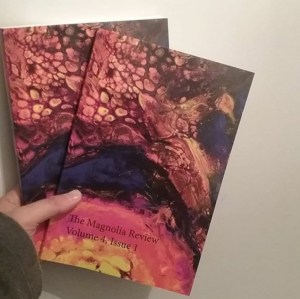
Purchase Copies of Volume 4, Issue 1

TMR is here

If you wish to donate to The Magnolia Review to assist with paying for contributor copies, please click Donate here.

If you wish to purchase physical copies of The Magnolia Review, Volume 4, Issue 1, please click here to Purchase One, Two, Three, or Four Copies. Or send your payment through your PayPal account to themagnoliareview@gmail.com. Select Send Money, Pay for Goods or Services. Send the amount for the number of issues you would like, as well as a mailing address.

Or mail your payment to:

The Magnolia Review
Suzanna Anderson
PO Box 1332
Reynoldsburg, OH 43068

(Including Shipping and Tax, $20.13 for one copy, $36.25 for two copies, $52.38 for three copies, and $68.50 for four copies. Please make checks payable to Suzanna Anderson.)

18% Funded! 7 Days to Go!

We are 18% Funded with 7 Days to Go! Thank you to all 31 backers. I appreciate your support.

I approved the final proof from the printer for Volume 4, Issue 1. They are getting ready to print, and I will have them before the end of November.

There is still time to donate, and please keep spreading the word. We only have 7 days to meet our funding goal.

Thank you!

Suzanna

Check out the Kickstarter project page here (https://www.kickstarter.com/projects/magnoliareview/the-magnolia-review-volume-4?ref=nav_search&result=project&term=the%20magnolia%20review).


18% Funded! 9 Days to Go!

Thank you to our 28 backers! We are 18% funded with 9 Days to Go! Thank you for every dollar of $1,123. Keep the pledges coming and keep spreading the word. Let’s make this dream happen.

Check out the Kickstarter project page here (https://www.kickstarter.com/projects/magnoliareview/the-magnolia-review-volume-4?ref=nav_search&result=project&term=the%20magnolia%20review).

Phoenix Rising 12 X 12 Clayboard jpeg

We made it to $1,000!

Thank you to our 28 backers! We are 18% funded with 15 Days to Go! We’ve reached a THOUSAND DOLLARS! Five thousand more and we’ll reach our $6,000 goal to print two volumes of The Magnolia Review, Volume 4, Issue 1, and Volume 4, Issue 2. Thank you for every dollar of $1,108. Keep the pledges coming and keep spreading the word. Let’s make this dream happen.

Check out the Kickstarter project page here (https://www.kickstarter.com/projects/magnoliareview/the-magnolia-review-volume-4?ref=nav_search&result=project&term=the%20magnolia%20review).

12% Funded! Printer Updates!

We’ve pledged $763 of the $6,000 goal with 23 backers! Thank you for your support. With 20 days to go, let’s make physical copies of The Magnolia Review Volume 4 a reality. (Check out the Kickstarter here)

I have proofs from the printer for Volume 4, Issue 1.

Proof from printer of Volume 4, Issue 1


Proof of cover from printer of Volume 4, Issue 1

Postcards have arrived for Volume 4, Issue 1, featuring Sandy Coomer’s Phoenix Rising.

Postcards of Sandy Coomer's Phoenix Rising, from Volume 4, Issue 1
Postcards of Sandy Coomer’s Phoenix Rising, from Volume 4, Issue 1

Please spread the word and keep pledging!

Thank you!

Suzanna

Toti O’Brien–Interview

Describe your creative space. Do you work at home, in public spaces, etc.?

How did you guess? Yes, I work in public spaces, as it comes to the creative process. They are various and unpredictable (the spaces), as I always carry a tiny notebook along. I can start scribbling whenever the occasion presents itself. Line at the post office. Transportation. My car, if I have arrived earlier for a commitment. A bench, anywhere. Doctor waiting rooms. Hospital waiting rooms (how many of those…)

I said: “as it comes to the creative process.” I review, of course, on a computer, mostly at home.

What kind of materials do you use? Do you write by hand or type? What is your favorite writing utensil?

I mentioned a tiny notebook. Hopefully it is at hand. Luckily, I seem to have developed the ability of finding anything writable-upon. I am amazed at the variety of matter that might work. Surfaces don’t need to be clear. I can write between lines, around lines, on top of them. As for the tracing instrument, everything goes. I confess having tried a lip liner, once, with poor results. So… I write by hand, yes, and I review on a computer. Two completely different processes.

What is your routine for writing?

There really isn’t one. But I have few “unwritten writing rules.” One is embedded in my previous answers: the first drafts inevitably occur in the open—interstitial, impromptu, spontaneous, free. Two—if something comes to mind I feel I should (or would like to) write, I have a deal with myself: yes, I will. No excuse. That seed will go into the ground. That thing, whatever it is, will be laid on paper, always. The third unwritten rule is that I devote time to review, rewrite, polish drafts, submit, edit, take care of all publishing practices, as often as possibly—daily is the ideal, and I rarely skip a day. Meaning a night, because the time I devote to such practice is nocturnal.

How long have you been writing? When did you start writing?

As a child. Which means I have done it for a lifetime. But I have immigrated twice, each time settling in a new language, and restarting from zero. Each new beginning took decades of adjustments.

Who is your intended, or ideal, audience? Who do you write for?

This is a fascinating question. For a long time I have “perceived” an audience I semi-consciously tried to reach as I wrote. I suppose it was banally made of those people I have loved the most, and somehow I have missed to reach in depth, or they haven’t responded to my wish of mutual understanding (relatives untimely passed or unavailable, failed relationships, teachers/mentors inaccessible or gone). Of course, that doesn’t make a crowd. Just a couple of souls from which I’d have liked to get a nod back. Through the years, these hidden interlocutors have vanished—and I like it better this way. When I write, now, it is like sealing a message in a bottle—for the unknown person who will enjoy what I have to say. I can’t wait to meet that person, yet waiting is exhilarating, and serene.

What inspires you to write? If you are blocked, what do you do?

I could describe what inspires me to write as “emergency.” Something (anything) that breaks the surface of my usual perceptions, insistently comes to mind, keeps whispering in my ear, demands for attention. Usually, a bizarre feeling, bizarre association of ideas, curious pattern of events. Like a knot that needs unraveling. Like a path in the woods I want to follow to see where it goes.

I don’t experience blocks. Not really. As I said, my writing is spontaneous and intermittent, though frequent. I’d continue on a piece because there is more to say, whenever there is more to say. If I pick up my text—wherever interrupted—and read it afresh, there will be certainly some corrections to make. As I make them and read over, something will follow. Even a little bit. Some things are irresistibly drafted—they pour out unstoppably. Some things accrete slowly. I don’t fret over them. They will bloom eventually. Nothing, ever, remains unfinished.

What other things do you do besides writing? Do you dance or play golf, etc.?

I am an artist and crafter, a professional dancer, singer, and musician. I have always done all these things for my living. They are my curse and my blessing.

What is your favorite part of the creative process?

The end, of course. The moment when, by magic, something is in front of me that didn’t exist before. Like when you smell the pie in the oven, and it has risen, and it is golden brown.

What is your advice to aspiring writers?

I am not too much of an advicer, alas.

But I could say: you know what you do, and why you do it.

Trust your contents, let them dig their own riverbed. Never harness them, never force them.

Try to never double-guess yourself.

Never listen for a single second to any negative comment you might receive, no matter how authoritative the dispenser.

Take all positive comments with a grain of salt.

Go on.


Check out Toti’s work in Volume 4, Issue 1.

Winner of The Magnolia Review Ink Award for Volume 4, Issue 2

I would like to thank Suzanna for giving me this opportunity. She should be proud of this issue and all the strong voices that it captures. Some of my favorite pieces are “Turtle Bay” by Henry Hintz, “Punk 4 a Day” by Diane Hoffman, the poems of Holly Day, Chuck Thompson, GTimothy Gordon, and Sarah A. Etlinger. If it were not for my first choice, “Two Fools” by Sarah A. Etlinger would be my winner because to its tightness, sharpness, and grace of language.


However, I find the excerpt of Theresa WilliamsFrom The Diary of Lea Knight to be the undeniable centerpiece of this issue. In this excerpt, Williams balances a combined feeling of prose and poetry in her writing. Her line work is crisp when called for and chaotic when necessary. In the best way possible, the notebook presentation of Williams’ project brings to mind Lynda Barry’s Syllabus, while the dark, real philosophizing evokes Alison Bechdel’s Fun Home and Are You My Mother? The work also takes me to old folktales, like Cinderella, that showcase familial catastrophes by an unhinged parent onto an innocent child, and the ensuing existential crises people feel under the force of an oppressive thumb. I think this slice of From The Diary of Lea Knight is a fascinating piece of sequential art, and I cannot wait to see more of it once it is inevitably published.


Dom Fonce is an undergrad English major at Youngstown State University. He’s been published in fiction, poetry, comics, and journalism. Some of his work can be found at Calliope of the University of Mount Union, Penguin Review, the Jambar, and the forthcoming summer 2017 issue of 3Elements Review. Collaborated with Vincent Butka (penciller), Jared Burton (inker and colorist), and Kaleena Spackman (letterer).