Check out David Anthony Sam‘s poetry collection, FINAL INVENTORY, available from Prolific Press here.
Congratulations, Gary Beck!
Kelsey Zimmerman–Interview
Describe your creative space. Do you work at home, in public spaces, etc.?
I usually write at home, or when I’m travelling. I consider writing very private, and it’s hard for me to do it in public.
What kind of materials do you use? Do you write by hand or type? What is your favorite writing utensil?
I typically type because it saves me time later, but there is something visceral I love about writing on paper. If I’m out and about, I keep a pen and notebook on me in case inspiration strikes.
What is your routine for writing?
Oh, I should have a routine! The closest thing I have to a routine at this point is thinking near-constantly to myself, “I should do some writing today.” And if it all works out, I do.
How long have you been writing? When did you start writing?
At least since young adolescence. I remember writing poetry for sure in 6th grade, but I could have started sooner. But I’ve certainly had stretches—some over a year long—of doing no writing whatsoever.
Who is your intended, or ideal, audience? Who do you write for?
I write for anyone who has ever felt like they’re alone—so, pretty much most everyone. The thing I love about poetry is how, if done right, it can take you into a moment so deeply and suddenly you realize: “I’ve had this moment before. I’ve felt what this poet is describing.” And there’s a sense of communion in that I strive for.
What inspires you to write? If you are blocked, what do you do?
Nature is the great inspiration for me. Or big emotions: I’m not much of a crier, so when I need to get my feelings out I write instead. If I’m blocked, going for a walk helps, especially in the woods.
What other things do you do besides writing? Do you dance or play golf, etc.?
Well, I have my full-time day job. I also knit, dabble in photography, and ride my bike. Spending time with friends and family is important to me, too.
What is your favorite part of the creative process?
That would have to be the feeling when everything clicks, and you look back at what you’ve done and are really excited about it.
What is your advice to aspiring writers?
I still consider myself an aspiring writer, so this is a loaded question! But I guess the advice I would give is it’s never too late to start, and never too late to get serious about it, either. Be patient with yourself. There isn’t a rush.
Check out Kelsey’s work in Volume 4, Issue 2.
Volume 5, Issue 2 Theme Announced!
The issue will be available July 2019.
The optional theme is Questions. See the Submit tab for details on how to submit. We accept photography, art, comics, creative nonfiction, fiction, flash fiction, experimental work, hybrid work, and poetry.
Diane Hoffman–Interview
Describe your creative space. Do you work at home, in public spaces, etc.?
I try to work in public spaces because I find at home to be too distracting. I also try to switch up the environment I work in because I find I tend to be more creative or just willing to write or draw whatever.
What kind of materials do you use? What mediums do you work in?
I like a fine tipped pen for making my lines, something like uniball. I recently have gotten into watercolor and marker more, but my go to tends to be colored pencil or just ink pens. I also love working with acrylic paint, but that’s not something I’ve ever used for comics.
What is your routine for art? Do you always sketch first?
I hate sketching first so I tend to nix that step if I think I can get away with it. For comics I tend to use one of those blue sketch pencils that won’t show the marks once the piece is scanned. But I hate sketching, I just want to draw something once and be done with it.
How long have you been making art? When did you start making art?
My mom grew up wanting to be an animator, so from a young age she has always pushed me to make art. I think around seven was when I started to actually care more about the art I was making. I started making comics around that age just for myself.
Who is your intended, or ideal, audience? Who do you make art for?
I try to make art for more of an older audience that likes to laugh or poke fun at things. I also just kind of make it for myself and what I think would be funny.
What inspires you to create? If you are blocked, what do you do?
Getting out of my comfort zone for sure helps me create more. Also being sad is usually when I’ve come up with some of my best ideas, although sadness and misery isn’t really ideal. If I’m blocked I usually take a long walk to clear my mind, and maybe settle down at a new location and start again.
What other things do you do besides art? Do you dance or play golf, etc.?
I’m a filmmaker, I like to direct, write, and edit. I’m also invested in the improv comedy scene. I’m moving to Manhattan in June, and I’m hoping to explore that scene more.
What is your favorite part of the creative process?
Being done! Having a thing to call my own!
I also like coming up with the idea, that part is kinda easy. I like making outlines and working out logistics when I’m writing fiction. It’s the executing part I’m not too fond of.
What is your advice to aspiring artists?
I’ve said it already, but get out of your comfort zone. Go somewhere new, try something new.
Check out Diane’s work in Volume 4, Issue 2.
William L. Spencer–Interview
Describe your creative space. Do you work at home, in public spaces, etc.?
I have an office, I’ve always set things up so I have a space that is basically an office. This one contains a 6-foot table from Ikea, a 17” iMac and a fancy adjustable office chair I purchased (with the client’s money) for one of the industrial videos I wrote and directed. I’ve cobbled together a couple pieces so I can use the desk either seated or standing up.
What kind of materials do you use? Do you write by hand or type?
I touch type about 90 wpm, so that’s the usual. I have written fiction in bars, restaurants, Starbucks, and I sort of like to do that in a way, you can pick up so much when you look up: a gesture, an expression, the way her hair falls across her forehead and the sort of quizzical expression that sometimes flickers across her face. If I lived in New York or Paris or Barcelona I’d probably do it more often. On the other hand, it’s pretty damned convenient not to change out of your pajamas.
What is your routine for writing?
If I have something underway I’m serious about that I really want to get done, like the one (unpublishably pornographic) novel I’ve written, then I set a schedule: first thing in the morning, work for either three hours or 1,000 words, whichever comes first. Then that’s it. This allows the rest of the day to be remorse-free. I think if one doesn’t do something like this, then the free-floating guilt of never getting enough done seems to hover constantly overhead, like Pigpen’s cloud. And of course your sub-mind continues to mess with the story anyway, no matter what else you think you’re doing.
How long have you been writing? When did you start writing?
I’ve worked as a writer of one sort or another my whole life, so I figure I’ve probably written maybe four million words altogether. I discovered Joseph Conrad and Guy de Maupassant in the bound sets of books that came with the bookcase from my uncle’s furniture store when I was about 12, and that was probably the beginning of my downfall. I wrote for the high school paper and wrote a little in college, but I really began trying to figure out fiction when I was between jobs in the 1980s. My wife and I sold a weekly newspaper in Washington state, moved the family to San Diego, and I freelanced until I got a job writing promotional campaigns for television stations. I worked with a guy who went by Captain Buzzword, who called me Billy Blue Sky. The art director was Tommy Two Tone. A great many creative meetings took place at the Mexican restaurant we favored. (I should probably put this into a story, huh?)
Who is your intended, or ideal, audience? Who do you write for?
Not long ago I ran across what Jeffrey Eugenides told The Paris Review, and it works for me, too: “…when you write, you should pretend you’re writing the best letter you ever wrote to the smartest friend you have. That way, you’ll never dumb things down. You won’t have to explain things that don’t need explaining. You’ll assume an intimacy and a natural shorthand, which is good because readers are smart and don’t wish to be condescended to. I think about the reader. I care about the reader. Not ‘audience.’ Not ‘readership.’ Just the reader.”
What inspires you to write? If you are blocked, what do you do?
I get an idea, it just sort of bubbles up, maybe for a story, maybe for a beginning or an ending or a situation or a character and it feels like something drops into focus and I see a way into it or out of it. For example, with this story, “Schoolboy,” for some reason or other I was thinking about that particular time in my life, probably ruminating on regrets, which is a bad idea to start with unless you’re some sort of creative artist and doomed to this sort of stuff, and the feeling for the ending came to me, not all of it, just the very last last line that embodies it all. The beginning of the story, the crank calls, getting the unknown girl on the phone, all that is just as it happened at the time. The second part, going to meet the girl, that’s all fiction. I think the beginning of the story isn’t very strong, and it only picks up momentum when the narrator gets off the bus. Or to put it another way, my fiction is much more interesting than my life. Which strikes me as the way things should be.
If you Google “writer’s block” you get about five and a half million hits. A guy who knew a lot more about this stuff than I do once said to me, “There is a time of breathing in and a time of breathing out.” And, “It’s not a machine, it’s a fountain.”
What other things do you do besides writing? Do you dance or play golf, etc.?
I play golf once a week with my son, see as much of my grandchildren as I can. I try to get enough exercise, and of course I read. I participate at the online writing site Scribophile using another name identity.
What is your favorite part of the creative process?
It used to be (like I’ve heard so many others say) “having written.” Writing is so damn hard. In the last few years, though, I’ve come to enjoy the process, messing around down there in the engine room, tinkering with things, changing out the pipes and valves, which I think is probably a healthier approach, though the grease and the spider webs can be annoying.
What is your advice to aspiring writers?
Let me be specific: Master your tools. If you don’t already, learn to touch type. You can do it in a week if that’s all you do that week. If you don’t know Microsoft Word top to bottom and a lot of the keyboard shortcuts, stop bitching about it and learn it. Read “Techniques of the Selling Writer” by Dwight Swain, memorize Strunk & White. Watch all of Brandon Sanderson’s lectures on YouTube and Jordan B. Peterson’s lectures on YouTube no matter what genre you’re interested in.
Keep in mind that making up a story entails both making up an author and making up an audience. That’s an interesting question for a writer to ask oneself when writing a story (or an interview): who am I being as author? Isn’t this story, like every story, a masquerade? Why do you believe your disguise is working? These are John Edgar Wideman’s ideas.
If you’re still young, figure out what you’re going to do for a day job that’s not going to turn you into somebody you don’t want to be.
And that’s enough of that.
Check out William’s work in Volume 4, Issue 2, and upcoming in Volume 5, Issue 1.
Congratulations, Gary Beck!
Check out Gary Beck‘s latest book, THE REPUBLIC OF DREAMS: AND OTHER ESSAYS, available here at Amazon.
Congratulations, Sarah A. Etlinger!
Check out Sarah A. Etlinger‘s poetry collection, NEVER ONE FOR PROMISES, available here. Her poems are available in Volume 4, Issue 2, and “Two Fools” was nominated for a Pushcart.
2018 Pushcart Nominations
The Magnolia Review Pushcart Nominations for 2018:
- Paul Lamb, “Fire Sermon,” Volume 4, Issue 1
- Anthony J. Mohr, “Crescent Drive,” Volume 4, Issue 1
- Ben Groner III, “Highways Like Frozen Rivers,” Volume 4, Issue 1
- Sarah A. Etlinger, “Two Fools,” Volume 4, Issue 2
- Henry Hitz, “Turtle Bay,” Volume 4, Issue 2
- Holly Day, “The Patch of Tulips I Never Planted,” Volume 4, Issue 2
Purchase Copies of Volume 4, Issue 1
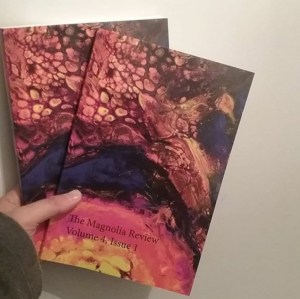
If you wish to donate to The Magnolia Review to assist with paying for contributor copies, please click Donate here.
If you wish to purchase physical copies of The Magnolia Review, Volume 4, Issue 1, please click here to Purchase One, Two, Three, or Four Copies. Or send your payment through your PayPal account to themagnoliareview@gmail.com. Select Send Money, Pay for Goods or Services. Send the amount for the number of issues you would like, as well as a mailing address.
Or mail your payment to:
The Magnolia Review
Suzanna Anderson
PO Box 1332
Reynoldsburg, OH 43068
(Including Shipping and Tax, $20.13 for one copy, $36.25 for two copies, $52.38 for three copies, and $68.50 for four copies. Please make checks payable to Suzanna Anderson.)
 The Magnolia Review