Holly Day–Interview

Describe your creative space. Do you work at home, in public spaces, etc.?

I work at home mostly—I have a very tiny cramped office I write in during the winter (because it has a heater in it) and I recently turned my son’s former bedroom into another office, which has a window looking out into the back yard that’s turning out to be more distracting than I’d hoped.

What kind of materials do you use? Do you write by hand or type? What is your favorite writing utensil?

I sometimes write by hand, but I mostly just write on my computer.

What is your routine for writing?

Wake up, do an hour or so of market research and submitting material, get my daughter ready for school, then write for the next 4-5 hours (until my daughter comes home from school).

How long have you been writing? When did you start writing?

Unofficially, I’ve been writing poetry and fiction since I was 4. Officially, I’ve been writing for publication since I was 15 (going on 32 years now).

Who is your intended, or ideal, audience? Who do you write for?

Initially, I always write for myself, and then the question of audience comes later.

What inspires you to write? If you are blocked, what do you do?

I’ve been writing for so long now that just the act of sitting at my desk inspires me to write. I worked as a journalist and a technical writer for a long time, so I didn’t have the luxury of being blocked—I always had intense deadlines to meet, so every moment I wasn’t writing was a moment dragging me closer to poverty. I maintain those same sort of deadlines for myself with fiction and poetry now, so I don’t really think about writer’s block.

What other things do you do besides writing? Do you dance or play golf, etc.?

I do a lot of handicrafts, like needlepoint and beadwork. When it’s nice out, I love to play in my garden. My husband and I write hiking and history books together, and a lot of our research involves big, long, wonderful walks through parks and the city, which I also love.

What is your favorite part of the creative process?

I love all of it. I love stumbling into a story or poem and feeling it grow into something separate from me. I love the moment after finishing something when I wonder, “How did this come about?” I love watching pages and pages fill up while I’m working on a book or a longer piece. It’s all wonderful.

What is your advice to aspiring writers?

Be persistent. Approach writing with joy.


Check out Holly’s work in Volume 3, Issue 1, and Volume 4, Issue 2. Two of her poems have been nominated for the Pushcart, “Fred, Half Dead, Beethoven In His Head” in Volume 3, Issue 1, and “The Patch of Tulips I Never Planted” in Volume 4, Issue 2.


Mela Blust–Interview

Describe your creative space. Do you work at home, in public spaces, etc.?

I usually work at home, as I tend to become distracted elsewhere. However, I jot down a verse or line on scrap paper occasionally whilst out and about, if it comes to me.

What kind of materials do you use? Do you write by hand or type? What is your favorite writing utensil?

I typically type when I write, unless I am out for the day and happen to think of something I want to record. I do have a connection with old typewriters, though.

What is your routine for writing?

I can feel when I need to write. Poetry is very cathartic, for me, and I can basically resign myself to an entire day writing because I need that release.

How long have you been writing? When did you start writing?

I started writing in the third grade. I entered a poetry contest and won. I have never stopped.

Who is your intended, or ideal, audience? Who do you write for?

I mostly write for myself, but I also write for my daughter.

What inspires you to write? If you are blocked, what do you do?

I am inspired by emotion. If I’m blocked, I let it take its course. It will come eventually.

What other things do you do besides writing? Do you dance or play golf, etc.?

I am an artist as well. I sculpt, paint, make jewelry, and pose for painting classes.

What is your favorite part of the creative process?

When it is finished, whatever I have created, and it is beautiful to behold.

What is your advice to aspiring writers?

Be determined. Never give up. If you are relentless, you can reach your dreams. I did.


Check out Mela’s work in Volume 4, Issue 2.


Kelsey Zimmerman–Interview

Describe your creative space. Do you work at home, in public spaces, etc.?

I usually write at home, or when I’m travelling. I consider writing very private, and it’s hard for me to do it in public.

What kind of materials do you use? Do you write by hand or type? What is your favorite writing utensil?

I typically type because it saves me time later, but there is something visceral I love about writing on paper. If I’m out and about, I keep a pen and notebook on me in case inspiration strikes.

What is your routine for writing?

Oh, I should have a routine! The closest thing I have to a routine at this point is thinking near-constantly to myself, “I should do some writing today.” And if it all works out, I do.

How long have you been writing? When did you start writing?

At least since young adolescence. I remember writing poetry for sure in 6th grade, but I could have started sooner. But I’ve certainly had stretches—some over a year long—of doing no writing whatsoever.

Who is your intended, or ideal, audience? Who do you write for?

I write for anyone who has ever felt like they’re alone—so, pretty much most everyone. The thing I love about poetry is how, if done right, it can take you into a moment so deeply and suddenly you realize: “I’ve had this moment before. I’ve felt what this poet is describing.” And there’s a sense of communion in that I strive for.

What inspires you to write? If you are blocked, what do you do?

Nature is the great inspiration for me. Or big emotions: I’m not much of a crier, so when I need to get my feelings out I write instead. If I’m blocked, going for a walk helps, especially in the woods.

What other things do you do besides writing? Do you dance or play golf, etc.?

Well, I have my full-time day job. I also knit, dabble in photography, and ride my bike. Spending time with friends and family is important to me, too.

What is your favorite part of the creative process?

That would have to be the feeling when everything clicks, and you look back at what you’ve done and are really excited about it.

What is your advice to aspiring writers?

I still consider myself an aspiring writer, so this is a loaded question! But I guess the advice I would give is it’s never too late to start, and never too late to get serious about it, either. Be patient with yourself. There isn’t a rush.


Check out Kelsey’s work in Volume 4, Issue 2.


Volume 5, Issue 2 Theme Announced!

The issue will be available July 2019.

The optional theme is Questions. See the Submit tab for details on how to submit. We accept photography, art, comics, creative nonfiction, fiction, flash fiction, experimental work, hybrid work, and poetry.

Congratulations, Sarah A. Etlinger!

Check out Sarah A. Etlinger‘s poetry collection, NEVER ONE FOR PROMISES, available here. Her poems are available in Volume 4, Issue 2, and “Two Fools” was nominated for a Pushcart.

Purchase Copies of Volume 4, Issue 1

TMR is here

If you wish to donate to The Magnolia Review to assist with paying for contributor copies, please click Donate here.

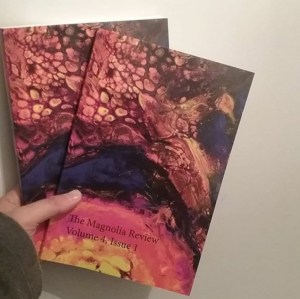
If you wish to purchase physical copies of The Magnolia Review, Volume 4, Issue 1, please click here to Purchase One, Two, Three, or Four Copies. Or send your payment through your PayPal account to themagnoliareview@gmail.com. Select Send Money, Pay for Goods or Services. Send the amount for the number of issues you would like, as well as a mailing address.

Or mail your payment to:

The Magnolia Review
Suzanna Anderson
PO Box 1332
Reynoldsburg, OH 43068

(Including Shipping and Tax, $20.13 for one copy, $36.25 for two copies, $52.38 for three copies, and $68.50 for four copies. Please make checks payable to Suzanna Anderson.)

Charles W. Brice–Interview

Creative space: My wife, the poet Judy Brice, and I are lucky enough to have two homes: one in Pittsburgh and one on Walloon Lake in Petoskey, MI. In Pittsburgh I have a wonderful garret on our third floor where I work and in Petoskey I have a second-floor study that looks out on the lake. The truth is, however, I can write anywhere: bookstores, cars, libraries, coffee houses, hotel rooms, park benches—anywhere.

Writing materials: Most of the time I write in a notebook that I keep in my back pocket. So I usually write the rough drafts of my poems by hand. I edit as I get them into the computer and then edit some more. I love my Pilot G-2 10 ink pens and hate to write with anything else.

Writing Routine: I read in the morning, poetry, novels, nonfiction, whatever, then, after lunch, go to my study and write all day. That’s not quite true: I consider submitting part of my writing day. Usually I’ll start something new or edit existing poems (some poems go through 30 edits), but always finish the day with submitting to at least one venue.

Writing, how long? I wrote poems in college but when I met my wife, Judy, I read some of her poetry and stopped writing myself for about twenty years. Her work was so good that I thought I’d be better off not writing anymore. I shouldn’t have done that, but it’s the truth. I started writing fiction again about 20 years ago. I got a few stories published but found that people really enjoyed my poems and they started getting published frequently so…I became a poet.

Audience: My first audience is my wife, Judy, then our son, Ariel, then my best and closest friends. I always have someone in mind when I write. Even though writing is a solitary process, it’s a relational process for me. I love to get my work published because I love to have people read it. It’s a special boon for me when I meet someone new because of my work. That’s happened when people have read my work on Facebook. I love it!

Inspiration: Reading other poets really inspires me, in fact, I’ve got this crazy idea that the worth of a particular poet I’m reading is directly proportional to the number of poems I get inspired to write while reading her/his work. I’m blessed, I’m never blocked. I think this is because, years ago, when I was in college, I had an English prof named Bernie Beaver who taught us that “anything can be a poem.” That piece of advice has been so helpful to me, Another teacher of mine, Jack Ridl, says that out of ten poems he’s written only one might be publishable, but the other nine were worth it. That’s a liberating thought, one that has helped me write about anything, anywhere! I’m also a member of a terrific writing group at our public library. I get a poem a week out of that group.

Other things I do: On my third floor in Pittsburgh sits the exact drum set that Ringo Starr played in the Beatles—a Ludwig Oyster Pearl drum set with Zildjian cymbals. I love playing them. I was in a rock band and a soul band when a young guy and have recently taken up jazz drumming. Also, I love taking long walks with my dog Mugsi. She’s a sweetie!

Favorite Part of Creative Process: I love editing—tinkering around with the original draft. I think of it as sculpting, getting the poem into a particular shape usually dictated, eventually, by the poem itself rather than by some design of mine. I agree with Billy Collins who says that the best part of the writing process is being surprised by what comes up in the poem, especially the ending.

Advice to writers: Get rid of your inner critic! When you hear that voice say, “it’s crap,” or “you’re no good,” give it the inner finger and write. Find your own writing rhythm. I write every day, and I’ve got friends who tell me that I’m so disciplined. I’m not disciplined! I love what I do and that’s what feels right for me. If you write only when the muse arrives, then that’s great. My wife writes only when the mood hits, and she’s a tremendous poet. Also, if you don’t want to submit your work, that’s fine. There’s no law that you have to, but if you want to publish your work, you’ve got to get it out there. You can’t catch fish if you ain’t got no bait, as the old blues song goes. Make submitting part of your normal writing day. Don’t take rejection personally. Wear rejection like a medal on your chest! It means you’re trying your best. Read like mad and eventually you’ll find your own voice. If you have a book, market it like crazy! The books don’t sell themselves! People who feel that marketing is somehow beneath them get what they deserve—few sales. They also are often the ones who whine that no one reads poetry anymore.

Check out Charles’s work in Volume 4, Issue 2, and the review of Mnemosyne’s Hand: Poems in Volume 4, Issue 2
What Now?

The project did not reach the goal of $6,000 for printing two issues of The Magnolia Review. However, I am working on finalizing Plan B, and all of my backers will be the first to know about this new option. Thank you for your support of this crazy project and dream of mine. Someday there will be print issues of The Magnolia Review. This is just part of the journey toward that dream. Stay tuned for some better news, and Happy November!

–Suzanna Anderson