Diane Hoffman–Interview

Describe your creative space. Do you work at home, in public spaces, etc.?

I try to work in public spaces because I find at home to be too distracting. I also try to switch up the environment I work in because I find I tend to be more creative or just willing to write or draw whatever.

What kind of materials do you use? What mediums do you work in?

I like a fine tipped pen for making my lines, something like uniball. I recently have gotten into watercolor and marker more, but my go to tends to be colored pencil or just ink pens. I also love working with acrylic paint, but that’s not something I’ve ever used for comics.

What is your routine for art? Do you always sketch first?

I hate sketching first so I tend to nix that step if I think I can get away with it. For comics I tend to use one of those blue sketch pencils that won’t show the marks once the piece is scanned. But I hate sketching, I just want to draw something once and be done with it.

How long have you been making art? When did you start making art?

My mom grew up wanting to be an animator, so from a young age she has always pushed me to make art. I think around seven was when I started to actually care more about the art I was making. I started making comics around that age just for myself.

Who is your intended, or ideal, audience? Who do you make art for?

I try to make art for more of an older audience that likes to laugh or poke fun at things. I also just kind of make it for myself and what I think would be funny.

What inspires you to create? If you are blocked, what do you do?

Getting out of my comfort zone for sure helps me create more. Also being sad is usually when I’ve come up with some of my best ideas, although sadness and misery isn’t really ideal. If I’m blocked I usually take a long walk to clear my mind, and maybe settle down at a new location and start again.

What other things do you do besides art? Do you dance or play golf, etc.?

I’m a filmmaker, I like to direct, write, and edit. I’m also invested in the improv comedy scene. I’m moving to Manhattan in June, and I’m hoping to explore that scene more.

What is your favorite part of the creative process?

Being done! Having a thing to call my own!

I also like coming up with the idea, that part is kinda easy. I like making outlines and working out logistics when I’m writing fiction. It’s the executing part I’m not too fond of.

What is your advice to aspiring artists?

I’ve said it already, but get out of your comfort zone. Go somewhere new, try something new.


Check out Diane’s work in Volume 4, Issue 2.

William L. Spencer–Interview

Describe your creative space. Do you work at home, in public spaces, etc.?

I have an office, I’ve always set things up so I have a space that is basically an office. This one contains a 6-foot table from Ikea, a 17” iMac and a fancy adjustable office chair I purchased (with the client’s money) for one of the industrial videos I wrote and directed. I’ve cobbled together a couple pieces so I can use the desk either seated or standing up.

What kind of materials do you use? Do you write by hand or type?

I touch type about 90 wpm, so that’s the usual. I have written fiction in bars, restaurants, Starbucks, and I sort of like to do that in a way, you can pick up so much when you look up: a gesture, an expression, the way her hair falls across her forehead and the sort of quizzical expression that sometimes flickers across her face. If I lived in New York or Paris or Barcelona I’d probably do it more often. On the other hand, it’s pretty damned convenient not to change out of your pajamas.

What is your routine for writing?

If I have something underway I’m serious about that I really want to get done, like the one (unpublishably pornographic) novel I’ve written, then I set a schedule: first thing in the morning, work for either three hours or 1,000 words, whichever comes first. Then that’s it. This allows the rest of the day to be remorse-free. I think if one doesn’t do something like this, then the free-floating guilt of never getting enough done seems to hover constantly overhead, like Pigpen’s cloud. And of course your sub-mind continues to mess with the story anyway, no matter what else you think you’re doing.

How long have you been writing? When did you start writing?

I’ve worked as a writer of one sort or another my whole life, so I figure I’ve probably written maybe four million words altogether. I discovered Joseph Conrad and Guy de Maupassant in the bound sets of books that came with the bookcase from my uncle’s furniture store when I was about 12, and that was probably the beginning of my downfall. I wrote for the high school paper and wrote a little in college, but I really began trying to figure out fiction when I was between jobs in the 1980s. My wife and I sold a weekly newspaper in Washington state, moved the family to San Diego, and I freelanced until I got a job writing promotional campaigns for television stations. I worked with a guy who went by Captain Buzzword, who called me Billy Blue Sky. The art director was Tommy Two Tone. A great many creative meetings took place at the Mexican restaurant we favored. (I should probably put this into a story, huh?)

Who is your intended, or ideal, audience? Who do you write for?

Not long ago I ran across what Jeffrey Eugenides told The Paris Review, and it works for me, too: “…when you write, you should pretend you’re writing the best letter you ever wrote to the smartest friend you have. That way, you’ll never dumb things down. You won’t have to explain things that don’t need explaining. You’ll assume an intimacy and a natural shorthand, which is good because readers are smart and don’t wish to be condescended to. I think about the reader. I care about the reader. Not ‘audience.’ Not ‘readership.’ Just the reader.”

What inspires you to write? If you are blocked, what do you do?

I get an idea, it just sort of bubbles up, maybe for a story, maybe for a beginning or an ending or a situation or a character and it feels like something drops into focus and I see a way into it or out of it. For example, with this story, “Schoolboy,” for some reason or other I was thinking about that particular time in my life, probably ruminating on regrets, which is a bad idea to start with unless you’re some sort of creative artist and doomed to this sort of stuff, and the feeling for the ending came to me, not all of it, just the very last last line that embodies it all. The beginning of the story, the crank calls, getting the unknown girl on the phone, all that is just as it happened at the time. The second part, going to meet the girl, that’s all fiction. I think the beginning of the story isn’t very strong, and it only picks up momentum when the narrator gets off the bus. Or to put it another way, my fiction is much more interesting than my life. Which strikes me as the way things should be.

If you Google “writer’s block” you get about five and a half million hits. A guy who knew a lot more about this stuff than I do once said to me, “There is a time of breathing in and a time of breathing out.” And, “It’s not a machine, it’s a fountain.”

What other things do you do besides writing? Do you dance or play golf, etc.?

I play golf once a week with my son, see as much of my grandchildren as I can. I try to get enough exercise, and of course I read. I participate at the online writing site Scribophile using another name identity.

What is your favorite part of the creative process?

It used to be (like I’ve heard so many others say) “having written.” Writing is so damn hard. In the last few years, though, I’ve come to enjoy the process, messing around down there in the engine room, tinkering with things, changing out the pipes and valves, which I think is probably a healthier approach, though the grease and the spider webs can be annoying.

What is your advice to aspiring writers?

Let me be specific: Master your tools. If you don’t already, learn to touch type. You can do it in a week if that’s all you do that week. If you don’t know Microsoft Word top to bottom and a lot of the keyboard shortcuts, stop bitching about it and learn it. Read “Techniques of the Selling Writer” by Dwight Swain, memorize Strunk & White. Watch all of Brandon Sanderson’s lectures on YouTube and Jordan B. Peterson’s lectures on YouTube no matter what genre you’re interested in.

Keep in mind that making up a story entails both making up an author and making up an audience. That’s an interesting question for a writer to ask oneself when writing a story (or an interview): who am I being as author? Isn’t this story, like every story, a masquerade? Why do you believe your disguise is working? These are John Edgar Wideman’s ideas.

If you’re still young, figure out what you’re going to do for a day job that’s not going to turn you into somebody you don’t want to be.

And that’s enough of that.


Check out William’s work in Volume 4, Issue 2, and upcoming in Volume 5, Issue 1.
Congratulations, Sarah A. Etlinger!

Check out Sarah A. Etlinger‘s poetry collection, NEVER ONE FOR PROMISES, available here. Her poems are available in Volume 4, Issue 2, and “Two Fools” was nominated for a Pushcart.

Purchase Copies of Volume 4, Issue 1

TMR is here

If you wish to donate to The Magnolia Review to assist with paying for contributor copies, please click Donate here.

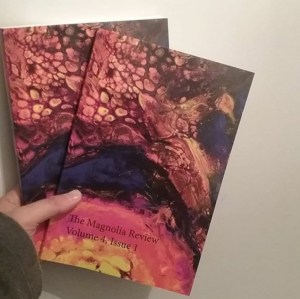
If you wish to purchase physical copies of The Magnolia Review, Volume 4, Issue 1, please click here to Purchase One, Two, Three, or Four Copies. Or send your payment through your PayPal account to themagnoliareview@gmail.com. Select Send Money, Pay for Goods or Services. Send the amount for the number of issues you would like, as well as a mailing address.

Or mail your payment to:

The Magnolia Review
Suzanna Anderson
PO Box 1332
Reynoldsburg, OH 43068

(Including Shipping and Tax, $20.13 for one copy, $36.25 for two copies, $52.38 for three copies, and $68.50 for four copies. Please make checks payable to Suzanna Anderson.)

Charles W. Brice–Interview

Creative space: My wife, the poet Judy Brice, and I are lucky enough to have two homes: one in Pittsburgh and one on Walloon Lake in Petoskey, MI. In Pittsburgh I have a wonderful garret on our third floor where I work and in Petoskey I have a second-floor study that looks out on the lake. The truth is, however, I can write anywhere: bookstores, cars, libraries, coffee houses, hotel rooms, park benches—anywhere.

Writing materials: Most of the time I write in a notebook that I keep in my back pocket. So I usually write the rough drafts of my poems by hand. I edit as I get them into the computer and then edit some more. I love my Pilot G-2 10 ink pens and hate to write with anything else.

Writing Routine: I read in the morning, poetry, novels, nonfiction, whatever, then, after lunch, go to my study and write all day. That’s not quite true: I consider submitting part of my writing day. Usually I’ll start something new or edit existing poems (some poems go through 30 edits), but always finish the day with submitting to at least one venue.

Writing, how long? I wrote poems in college but when I met my wife, Judy, I read some of her poetry and stopped writing myself for about twenty years. Her work was so good that I thought I’d be better off not writing anymore. I shouldn’t have done that, but it’s the truth. I started writing fiction again about 20 years ago. I got a few stories published but found that people really enjoyed my poems and they started getting published frequently so…I became a poet.

Audience: My first audience is my wife, Judy, then our son, Ariel, then my best and closest friends. I always have someone in mind when I write. Even though writing is a solitary process, it’s a relational process for me. I love to get my work published because I love to have people read it. It’s a special boon for me when I meet someone new because of my work. That’s happened when people have read my work on Facebook. I love it!

Inspiration: Reading other poets really inspires me, in fact, I’ve got this crazy idea that the worth of a particular poet I’m reading is directly proportional to the number of poems I get inspired to write while reading her/his work. I’m blessed, I’m never blocked. I think this is because, years ago, when I was in college, I had an English prof named Bernie Beaver who taught us that “anything can be a poem.” That piece of advice has been so helpful to me, Another teacher of mine, Jack Ridl, says that out of ten poems he’s written only one might be publishable, but the other nine were worth it. That’s a liberating thought, one that has helped me write about anything, anywhere! I’m also a member of a terrific writing group at our public library. I get a poem a week out of that group.

Other things I do: On my third floor in Pittsburgh sits the exact drum set that Ringo Starr played in the Beatles—a Ludwig Oyster Pearl drum set with Zildjian cymbals. I love playing them. I was in a rock band and a soul band when a young guy and have recently taken up jazz drumming. Also, I love taking long walks with my dog Mugsi. She’s a sweetie!

Favorite Part of Creative Process: I love editing—tinkering around with the original draft. I think of it as sculpting, getting the poem into a particular shape usually dictated, eventually, by the poem itself rather than by some design of mine. I agree with Billy Collins who says that the best part of the writing process is being surprised by what comes up in the poem, especially the ending.

Advice to writers: Get rid of your inner critic! When you hear that voice say, “it’s crap,” or “you’re no good,” give it the inner finger and write. Find your own writing rhythm. I write every day, and I’ve got friends who tell me that I’m so disciplined. I’m not disciplined! I love what I do and that’s what feels right for me. If you write only when the muse arrives, then that’s great. My wife writes only when the mood hits, and she’s a tremendous poet. Also, if you don’t want to submit your work, that’s fine. There’s no law that you have to, but if you want to publish your work, you’ve got to get it out there. You can’t catch fish if you ain’t got no bait, as the old blues song goes. Make submitting part of your normal writing day. Don’t take rejection personally. Wear rejection like a medal on your chest! It means you’re trying your best. Read like mad and eventually you’ll find your own voice. If you have a book, market it like crazy! The books don’t sell themselves! People who feel that marketing is somehow beneath them get what they deserve—few sales. They also are often the ones who whine that no one reads poetry anymore.

Check out Charles’s work in Volume 4, Issue 2, and the review of Mnemosyne’s Hand: Poems in Volume 4, Issue 2

What Now?

The project did not reach the goal of $6,000 for printing two issues of The Magnolia Review. However, I am working on finalizing Plan B, and all of my backers will be the first to know about this new option. Thank you for your support of this crazy project and dream of mine. Someday there will be print issues of The Magnolia Review. This is just part of the journey toward that dream. Stay tuned for some better news, and Happy November!

–Suzanna Anderson

18% Funded! 7 Days to Go!

We are 18% Funded with 7 Days to Go! Thank you to all 31 backers. I appreciate your support.

I approved the final proof from the printer for Volume 4, Issue 1. They are getting ready to print, and I will have them before the end of November.

There is still time to donate, and please keep spreading the word. We only have 7 days to meet our funding goal.

Thank you!

Suzanna

Check out the Kickstarter project page here (https://www.kickstarter.com/projects/magnoliareview/the-magnolia-review-volume-4?ref=nav_search&result=project&term=the%20magnolia%20review).


18% Funded! 9 Days to Go!

Thank you to our 28 backers! We are 18% funded with 9 Days to Go! Thank you for every dollar of $1,123. Keep the pledges coming and keep spreading the word. Let’s make this dream happen.

Check out the Kickstarter project page here (https://www.kickstarter.com/projects/magnoliareview/the-magnolia-review-volume-4?ref=nav_search&result=project&term=the%20magnolia%20review).

Phoenix Rising 12 X 12 Clayboard jpeg

Aloura Hattendorf–Interview

Describe your creative space. Do you work at home, in public spaces, etc.?

My creative space can be pretty much anywhere. I sometimes have random flashes of inspiration where I have to drop everything and write. It could be at the store, walking my dog, out with friends. For my brain, it doesn’t matter. I do prefer working alone in the quiet because it lets me think over what I’m trying to say. And when I need to read it back aloud to myself I don’t look like a lunatic.

What kind of materials do you use? Do you write by hand or type? What is your favorite writing utensil?

My preferred tools are simple: a (specifically) blue ball point pen, lined paper, and hours of alone time. I’m not entirely sure why I like blue ball point pens. The only thing I can think of that makes me really like them is how smooth they move, I guess. I like using loose paper because it allows me to easily look back on what I just wrote.

What is your routine for writing?

I have a structured system. I write what I have, expand on that, check tenses, then I add onto what I have until finally I type it.

How long have you been writing? When did you start writing.

I’ve been writing on and off for years but it wasn’t until about a year ago when I really started taking it seriously. I’ve been writing since I was little but I really got into it in high school and have been trying to incorporate it into my life ever since.

Who is your intended, or ideal, audience? Who do you write for?

I’ve never really thought about an audience. I want to write to those who need to express their emotions but just can’t. By that, I mean they’re almost stuck. One thing I’ve learned is that, personally, I can’t get anywhere without sorting out my feelings first. I know what it’s like to be stuck in a constant state for days, and days. It can drive the best people insane.

What inspires you to write? If you are blocked, what do you do?

My inspiration comes from my day to day life, even in stories. I try to take the highs and the lows of a day and turn them into something everyone can enjoy. I can make it rhyme, I can incorporate it into a fantasy story, it all depends on my mood. If I have a block I go and do something. It could be anything, it’s to jumpstart my engine and remember what my end goal is.

What other things do you do besides writing? Do you dance or play golf, etc.?

I like to draw and paint. I find it very soothing and at times, cathartic. It’s very nice to bring the people, things, or worlds that have been floating around in my head in both words and pictures. It helps organize my thoughts.

What is your favorite part of the creative process?

My favorite part is when it all falls together. It’s so rewarding. It feels like finding the missing piece to a puzzle you’ve been dying to solve and you finally did it, and it’s the most beautiful thing ever. It feels like a new kind of euphoria.

What is your advice to aspiring writers?

Use lots of emotion and this can apply to stories and poems. It’s emotion that drives us to become better. There’s never a moment when you’re not feeling, so it’s important to use that.


Check out Aloura’s work in Volume 4, Issue 2.