Jack D. Harvey–Interview

Describe your creative space. Do you work at home, in public spaces, etc.?

I work at home.

What kind of materials do you use? Do you write by hand or type? What is your favorite writing utensil?

I write by hand with a pen and when the poem gets close to its final form, I type it on Word on my computer.

What is your routine for writing?

I don’t have a set routine and write at all times of the day or night.

How long have you been writing? When did you start writing?

I have been writing some sixty-odd years, from the time I was about sixteen.

Who is your intended, or ideal, audience? Who do you write for?

I don’t have any intended or ideal audience. Basically I write because I feel compelled to write.

What inspires you to write? If you are blocked, what do you do?

Not sure what inspires me; the Greeks and the Romans had the idea that the muse breathes in (cf. the English word inspire- through the Greek- pneo, Latin spiro, “breathe in”) to you; in other words, there is some outside influence at work when you create something. I am not really sure whether this is true or not, but sometimes, while writing, words or thoughts come to me. From where, who knows? If I am blocked, I stop writing and come back to the piece later.

What other things do you do besides writing? Do you dance or play golf, etc.?

I study Chinese, go to the gym daily and walk daily with my wife.

What is your favorite part of the creative process?

Writing the piece and the usually laborious process of getting it to a final form.

What is your advice to aspiring writers?

Write as often as possible and read as much as you can; try to read the old masters—they are rarely wrong and you can learn a lot from them.

Check out Jack’s work in Volume 3, Issue 2.

Jesse Minkert–Interview

Describe your creative space. Do you work at home, in public spaces, etc.?

I have an office which was supposed to be a second bedroom, so it has long, shallow closets along one wall. The left one has a filing cabinet, two guitar cases, scraps of Foamcore, and a low rolling cabinet on which rests a Braille embosser. That’s a printer for Braille that creates bumps on heavy paper. The right closet is where my clothes and shoes are piled up. One or two folding card tables on the floor. My desk is by the door to the hall. A bookcase holds racks of Blues CDs and reference works. Under the windows are short shelves crammed with books, journals, and a boom box.

What kind of materials do you use? Do you write by hand or type? What is your favorite writing utensil?

I work at home on most of my tasks. I submit a lot, so that happens on the computer. I’m revising a novel, near the end, which means probably no more than one more year. That also happens on the computer. I started out as a visual artist, so I find myself still drawn to the flow of ink onto paper. I transcribe my notes once a month, create files of stages of editing, and with some luck, eventually, arrive at some poetry that doesn’t embarrass me.

I’ve been experimenting with different sizes of pen recently. Arthritis has made my thumbs almost useless. I’ve tried several ways to hold them so that thumbs are not necessary.

What is your routine for writing?

I’m terrible at maintaining routines. I start the mornings with submissions. I bounce back and forth between poems and the novel. Usually, more often than not, I think of something that interrupts the regular pattern, so I have to look into that immediately. I read too much news. After lunch, or at lunch, I go out with my spiral notebook and read and write in burger joints and Starbucks along Broadway on Capitol Hill in Seattle. With the release of Rookland, I’ve stepped up my attendance at open mics around town. I hustle spots as a featured reader. Performing before audiences is crucial to me. I write for the mood. I revise for the sound.

How long have you been writing? When did you start writing?

That story is too long for this questionnaire. Short version: as I mentioned, I was a visual artist. I got an M.A. as a sculptor in 1981. I moved to Seattle and my eyes started bleeding inside. Diabetic Retinopathy is a primary cause of blindness. Treatment was a matter of laser beams being shot at my retinae, over 1800 per eye. I came away with most of my vision, and with a resolve to find art to do that didn’t depend on vision. I started to write, for radio, stage plays, short stories, and poems. Figure I started about 1985. That’s 32 years.

Who is your intended, or ideal, audience? Who do you write for?

Always a tricky question. My novel audience may not resemble my poetry audience at all. Ideal audiences don’t exist. Real audiences exist, so I like them the best. Poetry on the page is one way to look at poetry, but poetry coming from a human mouth and into human ears is more exciting, more seductive, more terrifying. I work on page form, I take the look of a poem seriously, but I can’t imagine getting my blood to surge because of the shape of a poem on a page. I live for the microphone. Actually, I don’t need a microphone. Just listeners.

What inspires you to write? If you are blocked, what do you do?

I’m inspired to write from the fact that I have an expiration date. I need to get as much done as I can before I turn sour and undrinkable. Some days I walk away with a blank page. Some days I fill a page with useless crap. I have my box of tricks, some I learned in design classes in art school. It all comes down to three actions: transform, reshape, and rephrase.

What other things do you do besides writing? Do you dance or play golf, etc.?

I operate a nonprofit corporation called Arts and Visually Impaired Audiences. I create access projects to the arts for blind and visually impaired people. I’ve slowed down in recent years, but I still work with an organization called the Jack Straw Cultural Center on workshops for very young students, blind and sighted, to create projects related to installations in the Jack Straw New Media Gallery, and to train the staff and gallery artists on how to effectively interact with blind and visually impaired people. In the summers for the past 21 years, I’ve worked with kids 9-18 in audio production workshops. I lead the radio theater, or audio storytelling, section. It involves writing, teaching kids about what goes into stories, performance, production, and how to work with coaches and engineers.

What is your favorite part of the creative process?

In prose, I like the moment when I realize the sentence I’ve worked an hour to rebuild can now be reasonably spoken. In poetry, it’s that rush after the reading is done. Sure, sometimes people say nice things, good job, I loved that thing you read, etc., and I can’t say I don’t like that, but before that is the spinning head and the thumping heart. Okay, Minkert, they say, you really set yourself on fire this time.

What is your advice to aspiring writers?

Go over every phrase you have written down. If you believe you might have stumbled across it anywhere other than out of your head, cut it. Make up some phrase that nobody has ever heard before, and put that in its place. When reading to an audience, embrace the fear. If you find yourself reading with total confidence, you are screwing up. Fear keeps you honest. Fear means you are taking the risks you need to take. Submit a lot.

Check out Jesse’s work in Volume 3 Issue 2, and check out his book ROOKLAND here.
Ingrid Jendrzejewski–Interview

Describe your creative space. Do you work at home, in public spaces, etc.?

I work anywhere I get a chance to work.  I’m most comfortable at my desk or curled up somewhere cosy with my laptop, but if I need to get away from noise or distraction, libraries are my next favourite places, followed by coffee shops.  I used to feel I needed a quiet house and a particular desk to work, but I didn’t get nearly as much writing done in those days!

What kind of materials do you use? Do you write by hand or type? What is your favorite writing utensil?

I usually write on a computer because I like to feel free to edit, cut, rearrange and otherwise dramatically alter text, safe in the knowledge that I can always revert to an earlier draft.  When out and about, however, I always keep a notebook and pen on hand, just in case.  I often use one of those retractable pens with four different colours of ink, so that I can edit, scribble and make notes on my manuscripts.

What is your routine for writing?

I set aside as much time as I can for writing and editing.  If I’ve set aside time, I make myself sit down and try to work, whether or not I feel inspired.  (The words almost always come eventually, even if it feels impossible at the beginning of a session.)  I carry around a list of small things I want to accomplish—a scene, an outline, an edit, a writing exercise—so that I can make full use of small, unexpected fragments of time that may appear during the day.

How long have you been writing? When did you start writing?

Apparently, I wrote my first book at around five years old: it was a how-to manual for avoiding bedtime.  I’ve been writing in some form or other most of my life and studied creative writing at university (before switching tracks entirely), but I didn’t start sending work out until three years ago, after my daughter was born.  At that point, I decided to pull up my socks and treat writing as a vocation rather than a hobby, and I’ve been writing and submitting diligently ever since.

Who is your intended, or ideal, audience? Who do you write for?

I tend to write what I want to write, edit until I’m happy, and only worry about matching the finished piece to a potential audience when I’m trying to find a place to submit it.  As such, I’ve ended up writing everything from traditional genre pieces to some rather crazy experiments.  If a piece is well written and carefully edited, I figure there will almost certainly be a home for it somewhere, sometime.  Occasionally, I’ve written a piece in response to a journal’s prompt, but almost always, the resulting piece ends up somewhere else.

What inspires you to write? If you are blocked, what do you do?

I am inspired by lack of time.  I have so many things I want to write, that if I have the time, I’m driven to try to get some of the stuff in my head down on paper.  If I don’t have the time, I try to make it.  I rarely feel completely blocked, but if I’m not in the mood or writing is slow on one project, I either work on something else or simply force myself to write through the slowness.  For me, if I sit at my computer and type for long enough, I almost always end up with at least the seeds of something that can be developed.

What other things do you do besides writing? Do you dance or play golf, etc.?

I like programming, the game of go, cryptic crosswords, designing puzzles and going on adventures with my daughter.  I’ve also started strength training and can now deadlift 100kg—and counting.

What is your favorite part of the creative process?

Once in a great while, words flow and a piece springs onto the page nearly fully formed.  When this happens, it’s absolutely exhilarating…there’s nothing like it.  However, most of the time, I spend a lot of time writing my way into a piece, out of problems, and around what it is I later discover that I’m trying to write about.  Once I have a mess of words on the page, I can start editing, and this is often a fun, creative, playful process.  That first edit—when a story or poem starts clawing its way out of a jumble of words—is probably my favourite part of my creative process when I’m not in that rare magic writing zone.

What is your advice to aspiring writers?

Read a lot.  Write a lot.  Edit a lot.  Repeat, repeat, repeat.  Don’t wait until the time is right to do these things; life is always busy and messy, and there will probably never be a better time to write than now.  Sit down, do it, and don’t give up when it’s hard; sometimes you need to push a lot of text onto the page in order to make the magic to happen.  Just keep writing.  The dishes can wait.

Check out Ingrid’s work in Volume 3, Issue 2.

Check out Ingrid’s work in Volume

Hailey Hudson–Interview

Describe your creative space. Do you work at home, in public spaces, etc.?

I work at home at my desk. Occasionally I’ll go to my local library or coffee shop, but I’ve found that I can’t get any quality writing done in public—I’m too busy people-watching. So I stick to my bedroom!

What kind of materials do you use? Do you write by hand or type? What is your favorite writing utensil?

I use a MacBook Pro for almost everything I write. There is a special kind of magic that comes with writing by hand, though, so I’ll occasionally use a spiral-bound notebook and a Bic mechanical pencil. I’m not sure why the pencil has to be Bic, but I can’t stand any other kind.

What is your routine for writing?

My daily routine for writing is more or less as follows: in the morning, I spend a few hours working with the fitness websites that I freelance for. Then I’ll work on my novel—I’m currently in the editing stages of a YA dystopian novel. By then it’s typically lunchtime, and I don’t do any writing in the afternoon; I go to work (I work for a local nonprofit), run errands, or spend time with friends. Late at night, I come back to my laptop, browse Pinterest, and play around with ideas for flash fiction pieces.

How long have you been writing? When did you start writing?

I wrote my first “story” when I was five, but I didn’t get serious about writing until I was in middle school. During my senior year of high school, I became even more focused and began applying for freelance jobs and submitting my fiction to various publications.

Who is your intended, or ideal, audience? Who do you write for?

With my freelance jobs, I write to a very specific niche of people who own CrossFit gyms. However, my true love is fiction. I write a lot of YA, so my ideal audience is teens, but I like to think that all ages would enjoy my stories!

What inspires you to write? If you are blocked, what do you do?

Visiting new places, whether it’s an ethnic restaurant in my hometown or the mountains of South America (where I love to hike!), always floods my mind with ideas. If I’m running on fumes, I step away from my laptop in favor of a change of scenery, which normally fills me right up.

What other things do you do besides writing? Do you dance or play golf, etc.?

I play softball at a competitive level. I also work with a nonprofit that tutors underprivileged kids, and I’m obsessed with theater.

What is your favorite part of the creative process?

My favorite part of the creative process is either the very beginning, or close to the end. I love coming up with new ideas, starting from square one, and plotting how to make them happen, but I also love that moment near the end when all the puzzle pieces are beginning to fit together and I can see what I’ve created.

What is your advice to aspiring writers?

Don’t sit back and wait to be discovered. It’s completely possible for you to be published, but you have to be proactive and get your name out there. Submit to as many places as possible—and before you do so, edit again and again!

Check out Hailey’s work in Volume 3 Issue 2, and check out her blog here.


Gary Beck–Interview

  1. I work at home, or at Bryant Park
  2. I write by hand because I am a poor typist, and I use ballpoint pens.
  3. I’ve been writing for a long time in various cycles, determined by my work in theater when I focused on playwriting and translations of the classics.
  4. My intended audience is adults, ‘or older,’ ideally who enjoy issues, storytelling, and a commitment to literature.
  5. I have an urgent need to communicate with audience,s and I’m concerned with the state of the nation and the condition of the world. I have too much to do.
  6. I mentor some young people and play speed chess.
  7. The actual act of writing and the mental state when it just flows out of the pen.
  8. If it’s vitally important to you, persevere, no matter how you’re scorned or rejected. Never accept family or friends comments as objective assessment.

Check out Gary’s work in Volume 1, Issue 1, Volume 2, Issue 1, and Volume 3, Issue 2.

Ellie White–Interview

Describe your creative space. Do you work at home, in public spaces, etc.?

It varies. Sometimes, I am able to work at home. Other times, I have to make myself go somewhere like the library or a coffee shop. It really depends on how difficult it is for me write at the time. If I’m in a period of inspiration, it’s no problem for me to write at home. If I’m struggling to create new work, home is too comfortable. It’s too easy to get distracted there. I have to force myself into a public space where I am less comfortable to get anything done.

What kind of materials do you use? Do you write by hand or type? What is your favorite writing utensil?

When I started writing, I usually wrote by hand. I spent a lot of time at various writing groups, open mics, etc. and my laptop was very heavy to carry around. Now that laptops are much lighter, and I usually write alone, I type everything.

What is your routine for writing?

To be honest, I don’t have one. I write when I feel like writing, and if I don’t, I work on other creative projects. If it seems like it’s been a long time since I’ve written, I’ll push myself to write a few new pieces. But I don’t think I’ll ever be someone who writes every day. My writing comes in spurts.

How long have you been writing? When did you start writing?

I started writing in the fall of 2010, so about 7 years now. I always joke that I was peer pressured into becoming a poet because I used to attend poetry slams as a spectator, and a group of poets convinced me to attend their writing group, and then they convinced me to get on the mic, and so began my journey. I slammed for about 2 years, took a few workshop classes in undergrad, and then got accepted into an MFA program. I sometimes think about trying to slam again now that grad school is done.

Who is your intended, or ideal, audience? Who do you write for?

I’ve asked myself this question a lot. Ultimately, I think I am writing for anyone who may feel alone or misunderstood in their feelings. I write a lot about trauma, but I like to think that I write from a place of hope. My hope doesn’t necessarily look the way some people think it should. When you experience trauma, going back to “normal” afterwards isn’t really an option. You are different. The world looks different to you. There are times when you truly feel haunted by shit. But you are still alive in your little haunted house. So, I often write about living with my various ghosts.

What inspires you to write? If you are blocked, what do you do?

I find inspiration in the strangest things. Roadkill has inspired a number of my recent poems, as have some of the not-so-sexy realities of having sex. Life is messy, and I guess I find the mess inspiring. When I can’t write in my primary genre, which is poetry, I usually turn to something else. I sometimes write nonfiction. I also have a comic called “Uterus & Ellie.” I’m terrible at making comics since I can’t draw or use graphic design software worth a damn. But I have fun with it. I recently made a collage type thing because I’m blocked. It’s weird looking. I think I’ll hang it on the wall.

What other things do you do besides writing? Do you dance or play golf, etc.?

Well there’s the comic I just mentioned. Besides that, and my thrilling day job in insurance, about all I do is try to exercise enough to counteract my horrible diet. Around the time I turned 30, I started freaking out about my cardiovascular health. I ran outdoors for about 18 months, and then my knee started giving out about 5 months ago and it hasn’t healed. So, no more running. I was swimming for a bit, but then I developed a rare skin condition. So, no more swimming. I just joined a gym, so we’ll see how that goes.

What is your favorite part of the creative process?

I love writing the endings of my poems. I’ve got a thing for endings. I like for them to be unexpected, and I get really excited when I come up with something super creepy.

What is your advice to aspiring writers?

This is difficult because I never set out to become a writer. It just sort of happened and I ran with it. So, “run with it” maybe? Also, don’t freak out and think you’re not a writer anymore if you go through a period in your life where you don’t write much. Don’t let the people who have their daily writing routine set in stone make you feel like that is the only way to do this. Being a writer looks different for everybody. Do it on your terms, not someone else’s.

Check out Ellie’s work (Pushcart nomination) in Volume 3 Issue 2.

Ed Higgins–Interview

Describe your creative space. Do you work at home, in public spaces, etc.?

I have a loft above our old farm house’s kitchen. My extensive library’s there as is my MacBook—with internet connection. (Also, I taught fiction writing for years at my university & whenever there was an in-class writing session I’d also write/draft along with my students.)

What kind of materials do you use? Do you write by hand or type? What is your favorite writing utensil?

For some years now I’ve written exclusively on a MacBook. Before that by hand on legal pads. Once I have a word-processor draft of something I’m working on I generally do a printout & work on that by hand before returning to the Mac file & updating the revision. Mostly the work then continues on the revised draft file—but sometimes another printout before once again returning to the computer file. I like the ease of on-screen revision, but the printouts let me go back to an original version for review or recovery of something that’s been otherwise lost when I’ve frequently “saved” the on-screen version.

What is your routine for writing?

Time for writing has to be stolen from other intruding and/or necessary life activities. So I don’t write every day. But I do try to dedicate at least one-day-a-week exclusively to writing: some daytime hours, some late nite slogs—especially late nite slogs if something seems to be coming together (a poem, story, essay). I also carry with me a small note pad and will often jot down a thought, image, response to something I’ve seen, read, had a conversation about—to later follow-up on.

How long have you been writing? When did you start writing?

I started writing in college almost 50 years ago: really bad poetry; really bad fiction. But I kept at it, kept reading other writers, and eventually became better at seeing how poetry/fiction worked as craft.

Who is your intended, or ideal, audience? Who do you write for?

I generally don’t have an intended audience (unless I’m writing genre fiction/poetry; say, for science fiction). Mostly, I write for myself, for the kick I get out of playing around with words, characters, plot, emotion: the challenge of making something out of words that results in “Whoa, I did this & it’s pretty good!” I like the creative ‘click’ of affirmation that something worthwhile has come together—if the initial affirmation click is only from me!

What inspires you to write? If you are blocked, what do you do?

I’m more compelled than inspired as a writer. Compelled to make meaning(s) of this singular experience of our being—and being drawn to explore through words the many facets of living that catch my attention. I’m seldom “blocked” as a writer, but if something seems to be “stuck” I move on to something else in my shitty-drafts/unfinished file. Or I just go outside and play frisbee with my whippet. Or read: poetry, fiction, novels, catch-up on the too many magazines I subscribe to.

What other things do you do besides writing? Do you dance or play golf, etc.?

I’m small-acreage organic farmer with usually half-a-dozen steers, three pigs, a herd of chickens, a smaller herd of turkeys, and a Manx barncat to daily feed/water/care-for. And in summers I make hay (literally), plus other farm-related chores. While retired from full-time university-level teaching, I still teach a couple of World Literature through the academic year. I’m also Asst. Editor for an online journal, Brilliant Flash Fiction. And I belong to a 6-person writing group that meets bi-monthly to share in-process draft work.

What is your favorite part of the creative process?

Giddy to have finished something! While I like the getting-lost-in-to-completely-wrapped-up-with when I’m engaged on a writing project, completing a piece gives me the satisfaction to keep flagellating myself by pushing words around to make them happen into something I’m not self-embarrassed by.

What is your advice to aspiring writers?

Be persistent. Write, write, write. And read, read, read—especially your contemporaries who are putting out stuff you want to be a part of. And submit, submit, submit your work to journals you admire work in (there’s a horde of really fine online literary journals out there—read, read, read, then submit!). Don’t be discouraged by rejection: if the piece seems to need more work/polishing, do it; if you think as-is is still good, submit elsewhere. Finally, join a writing group: one that will give you honest, supportive feedback.

Check out Ed’s work in Volume 3, Issue 2.

Daniel Barbare–Interview

Describe your creative space. Do you work at home, in public spaces, etc.?

I work at home. Mostly in the living room. But I have gotten to the point where I create while

I’m on the move.

What kind of materials do you use? Do you write by hand or type? What is your favorite writing utensil?

Definitely the computer.

What is your routine for writing?

I hate to say it. But all day. All times.

How long have you been writing? When did you start writing?

Since 1981. 36 years.

Who is your intended, or ideal, audience? Who do you write for?

Whoever will read it.

What inspires you to write? If you are blocked, what do you do?

Almost anything, but when I get blocked I just work harder. Or clean the house. Mow grass.

What other things do you do besides writing? Do you dance or play golf, etc.?

Go to the movies. Travel locally.

What is your favorite part of the creative process?

Right when it clicks.

What is your advice to aspiring writers?

Love who you are, and love what you’re doing.

Check out Danny’s work in Volume I, Issue 2, Volume 2, Issue 1, and Volume 3, Issue 2.


Jessica Gigot–Interview

Describe your creative space. Do you work at home, in public spaces, etc.?

I have an office upstairs in our old farmhouse. During the winter months I love to hide up there with a warm cup of coffee and write on my computer. I also journal quite a bit in a notebook and start many of my poems by hand. I take it with me when traveling or if I can get away to a local coffee shop for a few hours. I also do quite a bit of writing in my journal at our kitchen table, before anyone else is up and the day begins. I used to have a fairly rigid morning writing routine that has been altered (for now) by our two, lovely, little girls. June is almost 3 and Eloise is 10 months. Now, I find windows of time to write when they are napping or later in the evening. The morning, however, is still my most productive time.

How long have you been writing? When did you start writing?

My mom has a box of my old writing projects that I started in elementary school. I wrote silly rhyming poems or made my own little magazines. I went into college wanting to be an English major, but fell in love with science and switched to Biology. Only after a solid decade of working in agricultural research did I feel a deep need to return to writing, poetry specifically.

Who is your intended, or ideal, audience? Who do you write for

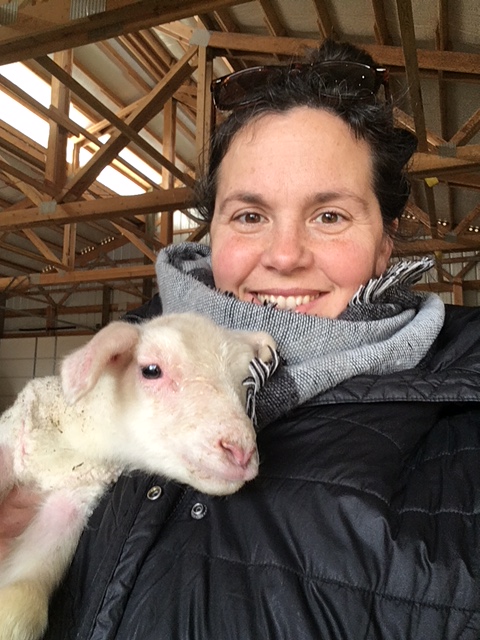
Hard to say, it is always changing. Sometimes I write poems that are in conversation with other poets. Other times, my poems are to or about a person and a place. I have a lot of new poems about our sheep, and I am hoping there is an audience for them. Who doesn’t love a good sheep poem, right?

What inspires you to write? If you are blocked, what do you do?

As I said before, I came back to writing sort of instinctually. I wasn’t satisfied with science writing and yearned for a better way to express myself and my ideas about land and farming. Now, it is just what I do. Poetry is how I process the world and make connections between my life and the experience of others. I also write songs, and I find that music helps me generate poem ideas as well. When I am really blocked I usually seek out a group that I can write with, in a one-a-day activity or a workshop. Being in community with other writers gets my ideas flowing!

What other things do you do besides writing? Do you dance or play golf, etc.?

We have a sheep and herb farm and that keeps me very busy. I definitely have less time to write during the spring and summer, but I take notes that I can return to in the winter. I play guitar and sing in an Americana trio with my husband and our friend Peter. On the farm I have a small studio where I do printmaking and ceramics, when I have the time. I also love to knit and do yoga and take long walks as well.

What is your favorite part of the creative process?

Making connections is my favorite part of the creative process. I write a lot of personal and narrative poems, and I am also working on some essays for the first time. I love it when a new sentence or image illuminates an idea I am writing about. I often stop and think, “Well, where did that come from?” Or when I am making something with my hands and a new poem pops in my head. Those mysterious connections between doing and listening, giving and receiving are alive in the creative process for me.

What is your advice to aspiring writers?

Keep writing and then write some more. Share your work when it is ready and don’t be afraid to be honest in your work. That is when the best stuff comes out on the page.

Check out Jessica’s work in Volume 4, Issue 1.

image1

Charles Joseph Albert–Interview

Describe your creative space. Do you work at home, in public spaces, etc.?

I have worked in just about every conceivable kind of space–at the office, on the dining room table, in bed. Coffee houses were my fave when I lived in San Francisco. But for the past 12 years, I’ve been writing in a little 6 foot by eight foot walled-off corner of my garage. It’s the perfect size. Big enough for a desk and bookshelf, but too small for visiting in-laws.

What kind of materials do you use? Do you write by hand or type? What is your favorite writing utensil?

I feel it’s important to keep up with the 21st century, and I do everything on a laptop now. I just hope dictation software improves faster than my arthritis, because this keyboard is killing me.

What is your routine for writing?

On a good day, I’m up at 6am and writing until 9, when I have to leave for work. 

How long have you been writing? When did you start writing?

I’d wanted to write since I was in high school, in the 1970’s, but my parents convinced me that I couldn’t support myself at that pursuit, and that I should go into physics instead. I don’t know if I fully appreciate their direction, since I am a lousy physicist, but I’m also far from supporting myself as a writer. Really, the only positive that came out of it all are a few physics poems.

Who is your intended, or ideal, audience? Who do you write for?

Every poem that I begin, I’m writing strictly for myself. But I have internalized the voices of a number of highly talented poets who contribute to eratosphere.com, where I’ve spent a lot of time, and when it comes to the inevitable editing and re-editing, I try to channel them.

What inspires you to write? If you are blocked, what do you do?

My inspirations tend to come from my dissatisfactions with the world. And I don’t think I’m in danger of running out any time soon.

What other things do you do besides writing? Do you dance or play golf, etc.?

I’m the father of three teenage boys, and so right now my wife and I are treading that narrow line between doing anything we can to help enrich their lives and not strangling them. 

I also play in an awesome all-trombone band called “South Bay Bones.” Here’s a link: http://www.southbaybones.org/

What is your favorite part of the creative process?

My favorite part is the initial writing down of the idea, the being a mere amanuensis of the muse. Even though that is only the raw, unedited part that may or may not (more probably may not, to be truthful) ever get refined to the point that it can be used, I still love being in that wonderful mode of cogitation where you completely lose yourself, you BECOME the thing you are trying to write.

What is your advice to aspiring writers?

My advice is to read in the genre you think you want to write in. I know a few amateur writers

who say “Oh, I just want to write. I don’t want to read anyone else!” and you can only imagine what that does for their craft, not to mention their understanding of the market and their ability to contribute to the on-going conversation. 

A really good way to read in your genre these days is through on-line writer’s forums. I am a member of a few of them and they’re fantastic. Invaluable!

Check out Charles’s work in Volume 3, Issue 2 and Volume 4, Issue 1.