Daniel Barbare–Interview

Describe your creative space. Do you work at home, in public spaces, etc.?

I work at home. Mostly in the living room. But I have gotten to the point where I create while

I’m on the move.

What kind of materials do you use? Do you write by hand or type? What is your favorite writing utensil?

Definitely the computer.

What is your routine for writing?

I hate to say it. But all day. All times.

How long have you been writing? When did you start writing?

Since 1981. 36 years.

Who is your intended, or ideal, audience? Who do you write for?

Whoever will read it.

What inspires you to write? If you are blocked, what do you do?

Almost anything, but when I get blocked I just work harder. Or clean the house. Mow grass.

What other things do you do besides writing? Do you dance or play golf, etc.?

Go to the movies. Travel locally.

What is your favorite part of the creative process?

Right when it clicks.

What is your advice to aspiring writers?

Love who you are, and love what you’re doing.

Check out Danny’s work in Volume I, Issue 2, Volume 2, Issue 1, and Volume 3, Issue 2.


Jessica Gigot–Interview

Describe your creative space. Do you work at home, in public spaces, etc.?

I have an office upstairs in our old farmhouse. During the winter months I love to hide up there with a warm cup of coffee and write on my computer. I also journal quite a bit in a notebook and start many of my poems by hand. I take it with me when traveling or if I can get away to a local coffee shop for a few hours. I also do quite a bit of writing in my journal at our kitchen table, before anyone else is up and the day begins. I used to have a fairly rigid morning writing routine that has been altered (for now) by our two, lovely, little girls. June is almost 3 and Eloise is 10 months. Now, I find windows of time to write when they are napping or later in the evening. The morning, however, is still my most productive time.

How long have you been writing? When did you start writing?

My mom has a box of my old writing projects that I started in elementary school. I wrote silly rhyming poems or made my own little magazines. I went into college wanting to be an English major, but fell in love with science and switched to Biology. Only after a solid decade of working in agricultural research did I feel a deep need to return to writing, poetry specifically.

Who is your intended, or ideal, audience? Who do you write for

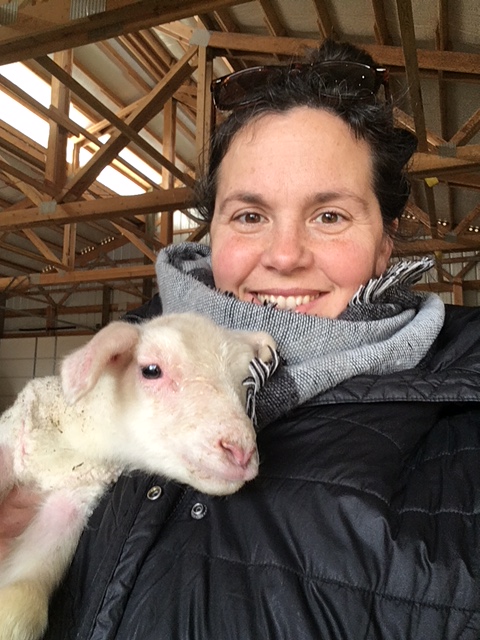
Hard to say, it is always changing. Sometimes I write poems that are in conversation with other poets. Other times, my poems are to or about a person and a place. I have a lot of new poems about our sheep, and I am hoping there is an audience for them. Who doesn’t love a good sheep poem, right?

What inspires you to write? If you are blocked, what do you do?

As I said before, I came back to writing sort of instinctually. I wasn’t satisfied with science writing and yearned for a better way to express myself and my ideas about land and farming. Now, it is just what I do. Poetry is how I process the world and make connections between my life and the experience of others. I also write songs, and I find that music helps me generate poem ideas as well. When I am really blocked I usually seek out a group that I can write with, in a one-a-day activity or a workshop. Being in community with other writers gets my ideas flowing!

What other things do you do besides writing? Do you dance or play golf, etc.?

We have a sheep and herb farm and that keeps me very busy. I definitely have less time to write during the spring and summer, but I take notes that I can return to in the winter. I play guitar and sing in an Americana trio with my husband and our friend Peter. On the farm I have a small studio where I do printmaking and ceramics, when I have the time. I also love to knit and do yoga and take long walks as well.

What is your favorite part of the creative process?

Making connections is my favorite part of the creative process. I write a lot of personal and narrative poems, and I am also working on some essays for the first time. I love it when a new sentence or image illuminates an idea I am writing about. I often stop and think, “Well, where did that come from?” Or when I am making something with my hands and a new poem pops in my head. Those mysterious connections between doing and listening, giving and receiving are alive in the creative process for me.

What is your advice to aspiring writers?

Keep writing and then write some more. Share your work when it is ready and don’t be afraid to be honest in your work. That is when the best stuff comes out on the page.

Check out Jessica’s work in Volume 4, Issue 1.

image1

Charles Joseph Albert–Interview

Describe your creative space. Do you work at home, in public spaces, etc.?

I have worked in just about every conceivable kind of space–at the office, on the dining room table, in bed. Coffee houses were my fave when I lived in San Francisco. But for the past 12 years, I’ve been writing in a little 6 foot by eight foot walled-off corner of my garage. It’s the perfect size. Big enough for a desk and bookshelf, but too small for visiting in-laws.

What kind of materials do you use? Do you write by hand or type? What is your favorite writing utensil?

I feel it’s important to keep up with the 21st century, and I do everything on a laptop now. I just hope dictation software improves faster than my arthritis, because this keyboard is killing me.

What is your routine for writing?

On a good day, I’m up at 6am and writing until 9, when I have to leave for work. 

How long have you been writing? When did you start writing?

I’d wanted to write since I was in high school, in the 1970’s, but my parents convinced me that I couldn’t support myself at that pursuit, and that I should go into physics instead. I don’t know if I fully appreciate their direction, since I am a lousy physicist, but I’m also far from supporting myself as a writer. Really, the only positive that came out of it all are a few physics poems.

Who is your intended, or ideal, audience? Who do you write for?

Every poem that I begin, I’m writing strictly for myself. But I have internalized the voices of a number of highly talented poets who contribute to eratosphere.com, where I’ve spent a lot of time, and when it comes to the inevitable editing and re-editing, I try to channel them.

What inspires you to write? If you are blocked, what do you do?

My inspirations tend to come from my dissatisfactions with the world. And I don’t think I’m in danger of running out any time soon.

What other things do you do besides writing? Do you dance or play golf, etc.?

I’m the father of three teenage boys, and so right now my wife and I are treading that narrow line between doing anything we can to help enrich their lives and not strangling them. 

I also play in an awesome all-trombone band called “South Bay Bones.” Here’s a link: http://www.southbaybones.org/

What is your favorite part of the creative process?

My favorite part is the initial writing down of the idea, the being a mere amanuensis of the muse. Even though that is only the raw, unedited part that may or may not (more probably may not, to be truthful) ever get refined to the point that it can be used, I still love being in that wonderful mode of cogitation where you completely lose yourself, you BECOME the thing you are trying to write.

What is your advice to aspiring writers?

My advice is to read in the genre you think you want to write in. I know a few amateur writers

who say “Oh, I just want to write. I don’t want to read anyone else!” and you can only imagine what that does for their craft, not to mention their understanding of the market and their ability to contribute to the on-going conversation. 

A really good way to read in your genre these days is through on-line writer’s forums. I am a member of a few of them and they’re fantastic. Invaluable!

Check out Charles’s work in Volume 3, Issue 2 and Volume 4, Issue 1.

Brian Orth–Interview

Describe your creative space. Do you work at home, in public spaces, etc.?

When it comes to a writing space, I personally find the solitude of the outdoors often initiates the creative thought process more than any other set location. However, the act of writing itself usually takes place in the evenings at my writing desk (I’m a bit of a night owl and enjoy my routine).

What kind of materials do you use? Do you write by hand or type? What is your favorite writing utensil?

Many of my poms take their first breath inside my head and resonate there for several days before anything is ever eventually written down. Usually this involves several rough drafts written down on whatever I have lying around when a certain phrase catches my attention. All final drafts are typed and saved on my laptop for I am far too forgetful to have them anywhere else.

What is your routine for writing?

Answered above.

How long have you been writing? When did you start writing?

I have always been intrigued by the creativeness of literature, in particular fiction and poetry, since I was a young boy. My first attempts at writing were juvenile attempts at the short story. As a sophomore in college, I took several literature courses and eventually moved into the Creative Writing degree with an emphasis on poetry.

Who is your intended, or ideal, audience? Who do you write for?

I do not begin any piece of work with an intended audience but rather try to focus on the emotion/experience that my imagination is working through. Much of the poetry and fiction I admire, however, has its roots in the spirituality of the human psyche.

What inspires you to write? If you are blocked, what do you do?

Again, nature often inspires me, and if I am feeling blocked, I try to remove myself from the hectic nature of day to day life and find solace in the natural world.

What other things do you do besides writing? Do you dance or play golf, etc.?

I have recently returned to the hobby of baseball card collecting and also enjoy fishing and hunting. If there is a chance to be outdoors, I take it.

What is your favorite part of the creative process?

My favorite part of the creative process is the fascinating experience of how the mind works its way from point A to point B without exactly knowing why it does.

What is your advice to aspiring writers?

Read everything you can get your hands on. Take the time to read the classics or contemporary and experimental works you may not necessarily always gravitate to because this can lead to discoveries that will expand your style as a writer.

Check out Brian’s work in the issue Volume 3, Issue 2.


Buffy Shutt–Interview

The Magnolia Review: Describe your creative space. Do you work at home, in public spaces, etc.?

Buffy Shutt: I do most of my writing in a room I call my studio, but which is technically one-third of the pool house. It has lots of windows and there is lavender growing under the facing window. I spend my downtime wondering whether I should get up and water it. Then I tell myself that lavender loves being dry so stop looking for an excuse to get up. I sit at a small white desk, more like an old-fashioned vanity that my daughter bought when she went to college. I am afraid one day she is going to say she wants it for her apartment. She’ll take it away, and I won’t be able to write anymore.  I also have a stand-up desk next to this table. I try to write standing as much as possible since I have totally bought into sitting is the new smoking.

What kind of materials do you use? Do you write by hand or type? What is your favorite writing utensil?

I love the idea of writing by hand using a beautiful fountain pen, but I have terrible penmanship and sometimes I can’t read my own writing. I use my laptop and phone. I was tied to my phone, as many of us are, when I worked full-time in the corporate world; a time when you might say that the phone used me. Now I use it! I use it to capture my stray thoughts, first lines and ideas by writing emails to myself. I usually have the phone on or near me so I am my own most constant correspondent—the perfect pen pal except that when I read what I wrote I’m sometimes not exactly sure what I meant, they read like fragments from a dream.

What is your routine for writing?

I start writing in the morning, break for lunch and if things are going well; go back for an afternoon session, finishing up around 6:30. (But not every day cause life intervenes but maybe four out of seven). I try to work on two stories at a time. I let them compete for my attention. If one story lets me down, I make the other one my best friend and let it curry my favor. I guess I am so competitive I’ve created a process to keep a rivalry going with myself.

How long have you been writing? When did you start writing?

I think I wrote my first story when I was ten. I feel like I have been writing all my life, but I interpret the notion of writing broadly.  My definition is either infinitely sensible or an elaborate defense for not always writing fiction. Writing might be journaling, emailing “letters” to my friends, writing work-related memos to convince the higher-ups of a good idea or to get funding, or drafting big presentations where concise bullet points might make all the difference in getting a green light. Writing is a tool that can be put to use for lots of different purposes—all (maybe most) legit.

Who is your intended, or ideal, audience? Who do you write for?

I write for my best friend. She is my not-so-secret audience. She is also my first reader. I trust that her comments will help me write the story I want to write and not the one she wishes she could read.

What inspires you to write? If you are blocked, what do you do?

Reading inspires me.  Hearing live music or seeing dance or theatre performances also inspires me. Movies inspire me, too. My son is a sculptor and I have become more and more interested in and inspired by the visual arts. Blocked? I take a walk. And walk some more. I complain to my husband, who is also a writer (Peter Seth, his recent novel is What It Was Like) and very sympathetic. I busy myself knocking a few things off my on-going, Virgo forged to-do list. I start something new—bam! off the cuff! flying blind!—with no real idea of where it might lead me.

What other things do you do besides writing? Do you dance or play golf, etc.?

I practice yoga four times a week. I meditate. I take courses at a local college with two friends. I love sports and watch a lot of baseball and basketball. Both big distractions but I love it. And I spend time with my grandson who has opened a world of possibility to me and reminds me to be in the present moment, a headspace writers need to cultivate.

What is your favorite part of the creative process?

I have two favorite parts: getting something to a point where I’m not afraid to share it and having a reader respond to it—favorably, I hope, but any response at all is welcome and good.

What is your advice to aspiring writers?

Read omnivorously. Don’t slack on the revising part. Revise relentlessly. Join/start a writers’ group. Being a part of a small writers’ group has been a source of tremendous support for me. First, you have to show up with something to read; second, you have to listen to what your friend-editors are saying, and third, you get to spend time talking about writing with other writers which brings home the sublime realization: Hey, I’m a writer!

Check out Buffy’s story, winner of The Magnolia Review Ink Award, in Volume 3, Issue 2!


Joan McNerney–Interview

The Magnolia Review: Describe your creative space. Do you work at home, in public spaces, etc.?

Joan McNerney: I do my writing at home.  Often ideas surface during the day when I am swimming or driving in my car.  This is especially true about poems I am currently working on.

TMR: What kind of materials do you use? Do you write by hand or type? What is your favorite writing utensil?

JM: I had no problem switching from writing in pen to working on a computer.  I like using the computer because changes are made easily and keeping different ideas on file is simplified.  It is important to make paper copies of all my work because of the danger of my computer “crashing”.  Also have backups such as a thumb drive and DVD copies.

TMR: What is your routine for writing?

JM: I check my email every day. When inspiration strikes that is my idea of writer’s paradise.  Now since my retirement, I can spend most of the day working on my poetry if the spirit moves me to do so.

TMR: How long have you been writing? When did you start writing?

JM: I started writing in high school and was published in Young America Sings.  There has been so much progress for writers now with the internet and all the exciting on-line publications.  The e-mail is also a wonderful way to communicate with editors.

TMR: Who is your intended, or ideal, audience? Who do you write for?

JM: Anyone who takes the time to read my writing is applauded.  Especially young readers are appreciated.  Now with so many TV channels, computer games and videos, let us hope that the art of reading still flourishes.  The ability to learn and acquire new information is very high for readers.  Also it takes a creative leap to join the author in a voyage through the pages of literature.

TMR: What inspires you to write? If you are blocked, what do you do?

JM: Who knows what sets off an inspiration?  The creative process is a mystery.  When blocked, I read both print and on the computer.  Some time might be spent checking out markets, clearing out old files on my hard drive, putting finishing touches on some “poetry in progress”.

TMR: What other things do you do besides writing? Do you dance or play golf, etc.?

JM: I swim as often possible and maintain a steady presence at our local pools.  Also there are regular adult classes which are actually very good.  There are six sessions of two hours each and taught by practicing professors.  This year the history of fairy tales and of jazz will be explored.  It is exciting to be introduced to new things.

TMR: What is your favorite part of the creative process?

JM: Some poems just come out as finished.  These are usually quite good.   Being inspired makes the whole process worthwhile.  Creativity is a gift which is misunderstood.  People often want to know “how much money do you make” as if everything can be reduced to dollars and cents.  They miss the point that seeing the world through the lens of an artist is a reward in itself.

I must admit getting acceptances and being published in beautiful journals both in print and on line is very fulfilling.  Having been nominated four times for Best of the Net was very exciting for me.  Some other publications have called me “best poet of the year” and some have named me “resident poet” while others have called me “poet of the month.  All this has been very gratifying.

TMR: What is your advice to aspiring writers?

JM: Have patience and perseverance.  Remember there is much joy in creativity and don’t let anyone dissuade you from pursuing your goals. You might seek out other poets at poetry readings and join some face book poetry groups.  Remember that a rejection is only the reaction of an editor at one juncture in space and time.  Forge onward.

Check out Joan’s work in Volume 3, Issue 2.